
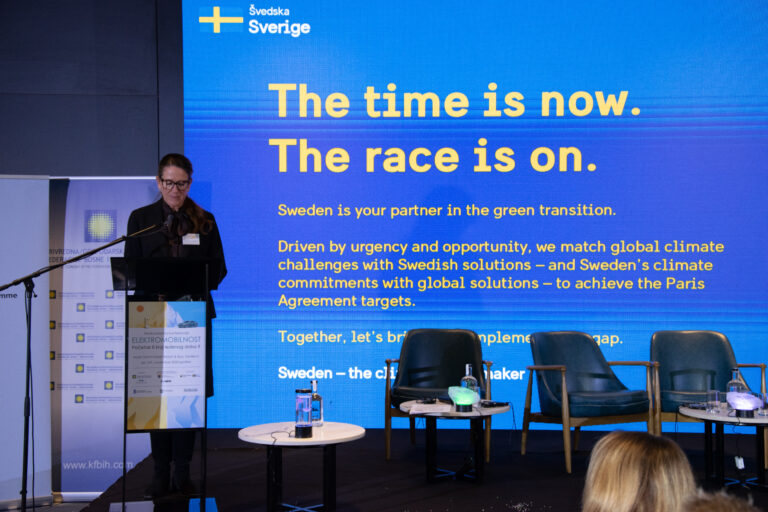
The Chamber of Economy of FBiH, with the support and co-financing of the Government of FBiH, the Federal Ministry of Development, Entrepreneurship and Crafts, the City of Sarajevo, UNDP and the Embassy of Sweden as the Partner Country, organized the first international conference “Electromobility: the beginning or the end of the ice age” on 6 and 7 November.
For the first time in Bosnia and Herzegovina, as well as in the region, the conference brought together leading experts from 10 EU and regional countries in one place: Sweden, Norway, Germany, Belgium, the Netherlands, Austria, Slovenia, Turkey, Serbia and Croatia.
In line with the conference motto “Living with clean lungs”, the president of the Chamber of Economy of FBiH, Mr. Mirsad Jašarspahić, Her Excellency the Ambassador of Sweden Helena Lagerlof and the UNDP Resident Representative in BiH, Mr. Renaud Meyer, symbolically planted a sapling and thus opened the conference.
At the same time, entrepreneurs gathered in the Association for Electromobility presented their message about environmentally friendly vehicles that do not pollute nature and at the same time represent an opportunity to combine tourism and environmental protection through the video “EV Demo show”, which was premiered as their voice during the opening of the conference.
The aim of the conference was to exchange knowledge, experience and break prejudices about electromobility. Through lectures, panel discussions and workshops, the conference brought together international experts, companies with proven experience, financial institutions, insurance companies, policymakers, and experts in the sustainable transport sector – passenger and freight electrified programs, energy, and technology.
At the opening of the conference, in addition to the president of the Chamber of Economy of FBiH, addresses were also given by Ms. Sanja Kapetina on behalf of the Ministry of Foreign Trade and Economic Relations of BiH, Her Excellency the Ambassador of Sweden Helena Lagerlof and the UNDP Resident Representative in BiH, Mr. Renaud Meyer.
“In the Chamber of Economy of FBiH, we have been dealing with electromobility for a long time in our work with our member companies – business entities, and now, after our accumulated experience and our driven electric kilometers throughout BiH and beyond, and based on numerous contacts, we decided that it was time for the first international conference in BiH, which will demystify numerous prejudices and provide insights into new knowledge and new contacts for those present. In addition, with an innovative approach to organizing the conference and its content, we showed the breadth that electromobility brings, that it is not only electric vehicles, but also numerous innovations and business opportunities it brings through the aspect of digitalization,” said Mirsad Jašarspahić, president of the Chamber of Economy of FBiH.
The introductory lecture within Panel I “Voice of Industry”, powered by Star Import Mercedes-Benz, was given by Ms. Ellen Hiep, representative of the Dutch Association of Electric Vehicle Drivers, who conveyed the message that all the challenges currently present in BiH also existed in all other countries, where they now have other challenges as well, and that it is inevitable that “growing up hurts” and that therefore it is necessary to “celebrate every new installed charger and every step forward.” Within the panel of the same name moderated by Anela Karahasan, all guest country representatives shared their experiences about the number of electric vehicles, current challenges, the key to success and how they see the future of electromobility as the beginning or the end of the ice age. In this way, those present gained insight into the situation from country to country, in order to choose the best path for BiH synergistically.
In the continuation of the first day, more precisely within Panel II, representatives of institutions and international organizations, under the moderation of Mr. Derviš Hadžimuhamedović, discussed the modalities of sustainable transport from the perspective of the advocacy table representatives. A special contribution to this panel was also made by Her Excellency Maria Molina Toledo, Ambassador of Spain.
In the second part of the day, within Block 1: ICE vs BEV, participants had the opportunity to hear firsthand that in Scandinavian countries (especially Norway, as presented in his speech by Mr. Petter Haugneland) the ice age, i.e. vehicles with internal combustion engines, has come to an end, and those present received information on how and in what way this was achieved. A similar overview of the situation and challenges was presented from the perspective of Mr. Magnus Johansson, Elbil Sverige Sweden.
Those present were also interested and impressed by all the experiences of Mr. Franz Liebmann from Austria on the journey of 777,777 electric kilometers. Through charm and enthusiasm, Mr. Liebmann presented the first beginnings and overcoming infrastructure challenges, with the conviction that every socket is a potential charger.
Josip Šarić on behalf of the company Etiris, also a member of the Association for Electromobility, premiered the first ChargerBIH application.
Those present were especially interested in Panel III „Life after the vehicle – quo vadis”, powered by Mozaik Foundation & Sparkasse Bank. Through an interactive discussion, the panelists talked about the opportunities but also the challenges brought by batteries in BiH, namely Ms. Elma Babić-Džihanić from the perspective of the authorized operator of the system for electronic and electrical waste, Mr. Damir Uzunović from the perspective of the automotive industry and new EU regulations regarding the Digital Passport. A solution for other waste categories, as well as a potential solution for batteries once the legal framework for it is in place, was presented by Ms. Vilma Tunjić Juzbašić with the ReUseChain platform, while Mr. Amel Agić, Director of the Corporate Banking Sector at Sparkasse Bank, provided insight into the potentials and possibilities that financial institutions have in this domain, especially Sparkasse Bank by moving away from the classic bank model, thus providing additional support to the business sector in cooperation with the Mozaik Foundation. Prof. Dr. Omar Noshin gave those present more details about EU requirements and the Digital Passport, repeatedly emphasizing the sentence: “Every crisis is also an opportunity.” A special review and attention to the challenges in the disposal of batteries from smokeless devices, as well as the contribution in the context of the circular economy, was given by Mr. Lorand Szabo, General Director of Phillip Morris for BiH.
The end of the first day was spiced up by the Swedish eMobility fika, within which companies from Sweden were presented along with traditional Swedish cookies and coffee. Special attention was drawn by the presentations of Scania and Volvo Trucks given their experience in electrifying freight transport, which is still not present in BiH. The presentations of other Swedish companies were equally significant, especially because they touched on the connection and joint action of the academic community, decision-makers and the business sector.
The second day of the conference began with Block 2: Safety – energetic and expert presentations by Prof. Dr. Branislav B. Aleksandrović and Vlada Plemić, representatives of Vozim na struju, Serbia, and Vanja Katić on behalf of EV Clinic, Croatia, which demystified numerous prejudices and provoked the audience with many questions.
Within Panel IV: ESG in the vehicle fleet: sustainable driving on the road, powered by Raiffeisen, Mr. Nedim Milišić, Head of the Department for Corporate Relations and Financial Institutions Management at Raiffeisen, spoke about the experiences of companies from the real sector, opportunities, challenges and savings brought by sustainable transport and what ESG means in the vehicle fleet, together with representatives of the following companies: Mr. Damir Numić, Director of Green Light Logistic, Mr. Emin Efendira, Director of Mega-Trans, Ms. Urška Fon Sattler, Director of Scania East Adriatic Region, Mr. Muamer Musić, Volvo Trucks, and Mr. Joško Matijević, Professional Taxi Association for the Promotion of EV in Activities, Split. The panelists shared their experiences and examples, where it was especially interesting to see the contribution of ESG from the perspective of a financial institution, here specifically how Raiffeisen does it, with the joint conclusion of all panelists that ESG in the vehicle fleet is not an impossible and unattainable mission, and that even small steps make changes.
Regarding this example, those present had the opportunity to see the premiere for the BiH market of the Andolu Isuzu BIG.e electric delivery vehicle, with all its potentials and modularity, according to different needs and industries.
And how to secure debt collection was presented to those present within the Side event by Mr. Sanjin Tankosić on behalf of Wiener Insurance VIG.
Block 3: From enthusiasm to new business opportunities, began with Prof. Dr. Mr. Omar Noshin on behalf of AVESTA Holding, Belgium, with the presentation “Battery as an energy storage technology – an opportunity for electric vehicles and stationary applications”. Prof. Dr. Noshin, through his open questions, encouraged those present to think and ask new, numerous questions they had not considered before. At the same time, Mr. Ignac Završnik, Society for Mobility DEMS, presented the policies and practices that led to the expansion of infrastructure for charging electric vehicles, also as new business opportunities in Slovenia, and how to apply this in BiH.
Panel V “From enthusiasm to new business opportunities”, powered by Qelo, began with an interesting but truthful presentation by Mr. Predrag Šeatović about Qelo’s business model in Croatia, from initial losses to an exceptional business opportunity and an innovative story in the form of bonds. In that spirit, the discussion continued with representatives of the companies: Velimir Jeremić, Director of DEKRA Serbia, Hans-Jurgen Wittmann, Director of GTAI for the Western Balkans and with a special focus on OEM, Adnan Bosović, expert associate for the development of distribution networks at EP BiH, Magnus Johansson, ELBIL Sweden, and Darko Zeljković, eMobility Business Developer at Schneider Electric Serbia.
The final Panel VI titled “Towards climate neutrality in BiH: Sarajevo’s journey through NetZeroCities” provided insights into the achievements and progress made by the City of Sarajevo on the path to climate neutrality and also insight into the activities of NetZeroCities, which recognizes the need for cities to develop specific strategies adapted to local and regional contexts.
Although the conference had intensive content, for additional comfort participants had at their disposal numerous accompanying contents such as the Premium Business Lounge Inspired by Kare Design, Business Lounge Fun & Network by Bingo, as well as the exhibition section of electric and hybrid vehicles with the possibility of scheduling test drives. Particularly interesting was the education and empowerment of women in business on the topic of driving electric vehicles and test drives organized in cooperation with the Association of Authorized Car Dealers and Traders.
In conclusion of this two-day conference, the present representatives of 10 countries unanimously confirmed and stated that it is clear that Bosnia and Herzegovina is at the very crossroads of Europe’s green transition, but that with their examples and support they are available to ensure that this transition in BiH begins: ambitiously, realistically and ready for action.

