
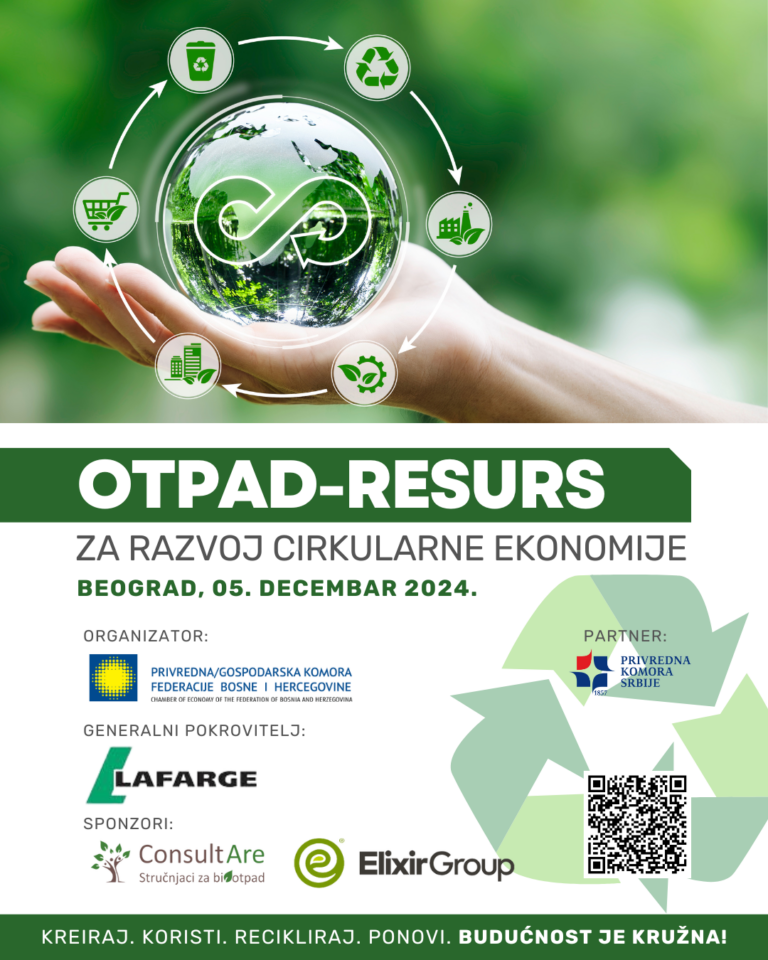
The Chamber of Economy of the Federation of Bosnia and Herzegovina, in partnership with the Chamber of Commerce of Serbia, is organizing the international conference “WASTE-RESOURCE for the development of the circular economy”. This important event will bring together leaders in the green transition, decision-makers, institutes, experts, entrepreneurs, financiers, public utility companies, representatives of the NGO sector and the media.
Circular economy: A path to sustainable resource use
The conference will focus on promoting the circular economy as a model that enables sustainable resource use while preserving a healthy and clean environment. Since 2015, the European Union has introduced significant changes to the legal framework, allocated substantial funds, and created new job opportunities with the aim of modernizing the economy and opening new jobs.
The current linear economic model, which relies on uncontrolled exploitation of natural resources, needs to be transformed. The circular economy influences changes in business models, habits and ways of thinking, both among producers and consumers. Through eco-design of products, their lifespan is extended and waste is reduced.
According to the European Commission’s new Circular Economy Action Plan (CEAP), ambitious goals have been set, including:
• Making sustainable products the norm in the EU.
• Focusing on sectors with high circularity potential, including electronics, packaging, plastics, textiles and construction.
• Reducing total waste generation and halving the amount of residual municipal waste by 2030.
• Empowering consumers and public procurement buyers.
• Leading global efforts in the field of circular economy.
Composting as a key factor
“In Croatia, around 400,000 tons of bio-waste suitable for composting are generated annually, and the potential across the entire region reaches 2.7 million tons. Utilizing this resource can significantly reduce the amount of waste in landfills and produce high-quality compost, which can be used as organic fertilizer in agriculture.
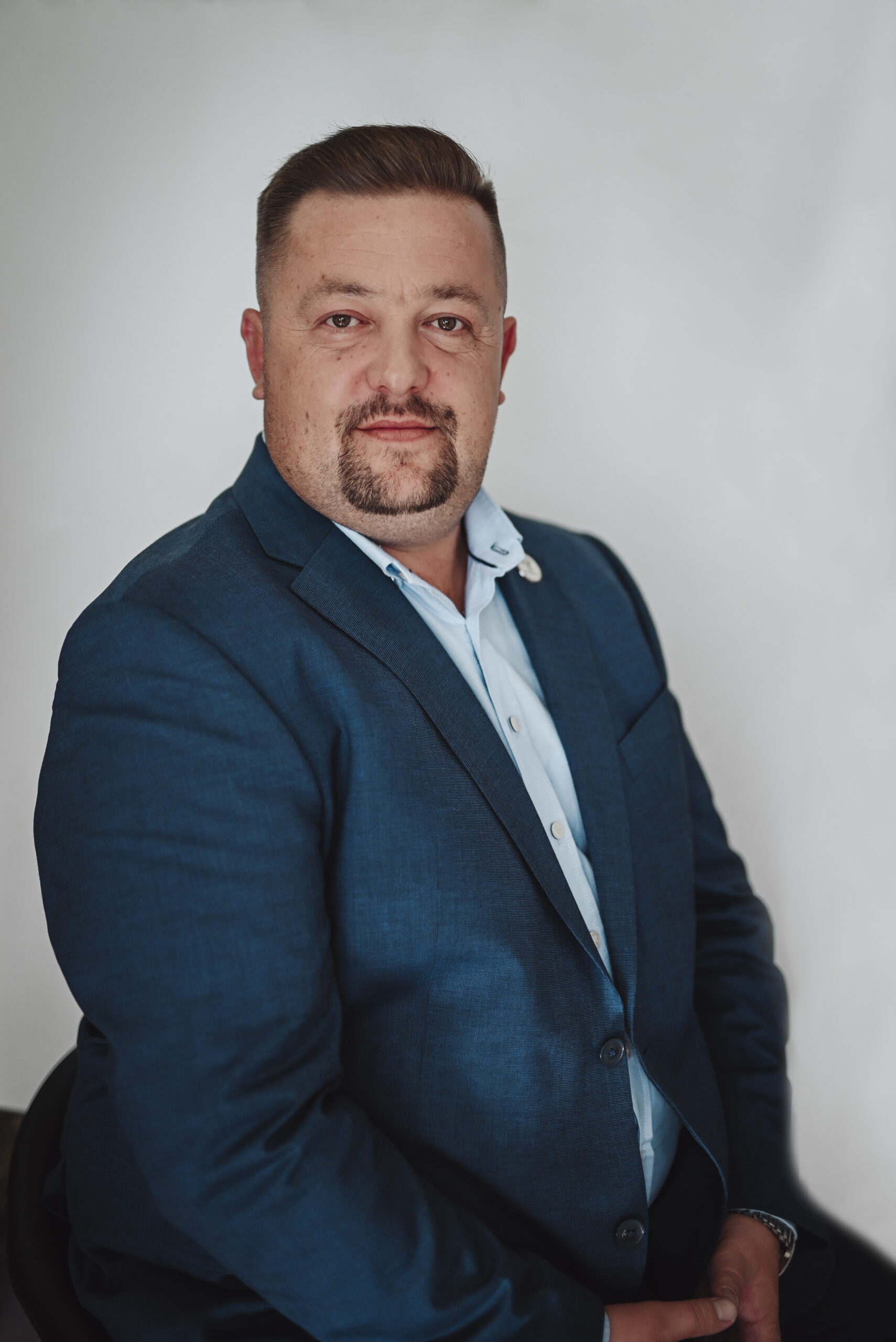
Examples of good practice from Croatia, such as the cities of Daruvar, Osijek, Koprivnica, Prelog and the island of Krk, show how bio-waste is successfully collected and processed. These projects not only contribute to waste reduction, but also bring significant environmental and economic benefits. As the director of Consultare and president of the Croatian Composting Association, I believe this conference is a key opportunity to present the potential of composting and to establish new partnerships that will contribute to the development of the circular economy in the region,” says Marko List, director of Consultare, Croatia.
Join the event
This conference represents a unique opportunity to exchange knowledge, share best practices and establish new partnerships. Do not miss the opportunity to be part of this significant event and contribute to the development of the circular economy in the region.
Register today via the link: APPLICATION/WASTE-RESOURCE for the development of the circular economy (google.com).
General sponsor of the conference: Cementara Lafarge, Serbia.

