
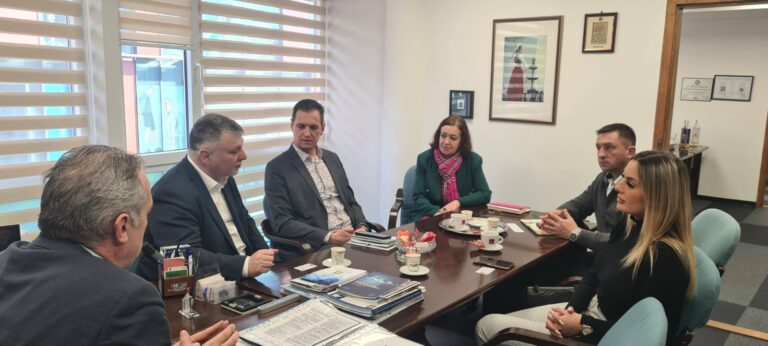
The leaders of the EU4Energy Project visited the Chamber of Economy of the Federation of BiH on 27.12.2023, where they were received by President Mirsad Jašarspahić and associates.
Project leader Zoran Bogunović (senior expert) briefly presented the goals of the EU4Energy Project, whose main activities are aimed at improving energy and climate policy in Bosnia and Herzegovina, with an emphasis on technical support in harmonizing domestic legislation at all levels with the legislation of the European Union.
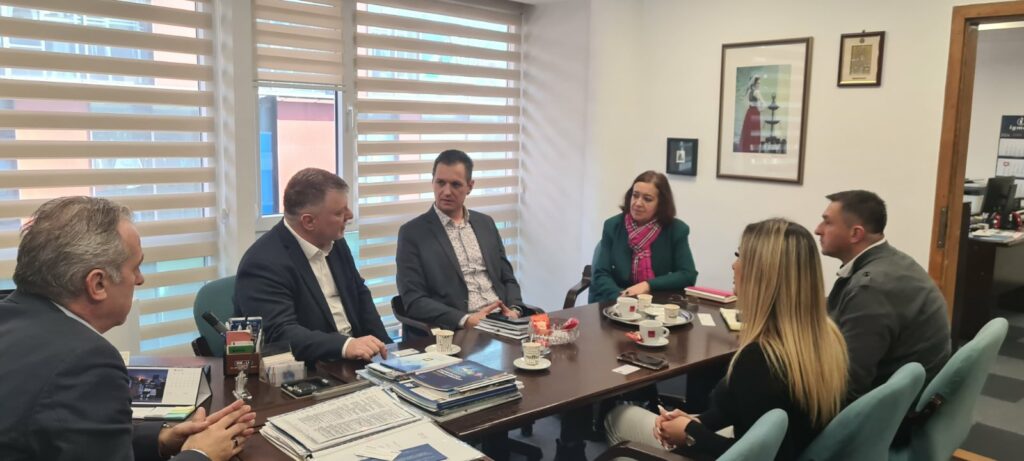
At the meeting, special attention was devoted to measures for intensifying these activities. Representatives of the Chamber of Economy of the Federation of BiH expressed interest in expanding cooperation to other areas of the economy besides energy and climate, as this would certainly be an incentive for the overall development of the economy in our country.
After presenting the sectors in which cooperation could be achieved, it was agreed that the Chamber of Economy of the Federation of BiH would propose to the EU4Energy Project topics and activities that it considers most interesting for member companies of the Chamber, thereby establishing longer-term cooperation with the EU4Energy Project, strengthening activities on joint projects financed by EU funds and encouraging new investments.
It was also concluded that, as one of the recognized stakeholders in this process, the Chamber of Economy of the Federation of BiH, through the implementation of infrastructure and energy projects, would have multiple benefits, along with concrete results and products of domestic companies, and domestic human and material resources would also participate in these activities. This refers to informing business entities about upcoming obligations from the aspect of clean green energy, energy transition, just transition, as well as opportunities to participate in projects and draw funds from pre-accession funds for the implementation of transition projects; as well as workshops on new business models arising from the needs of just transition and the set of newly adopted electricity laws.
Bearing in mind that there is not much time left until 1.1.2026, when the mechanism for cross-border carbon adjustment (CBAM) will come into effect, which introduces a tax that will be charged on electricity, aluminum, cement, fertilizer, hydrogen, iron and steel that will be exported to the EU, it is important in this transitional period to establish the necessary legislation and protect the economy from paying taxes and losing competitiveness.

