
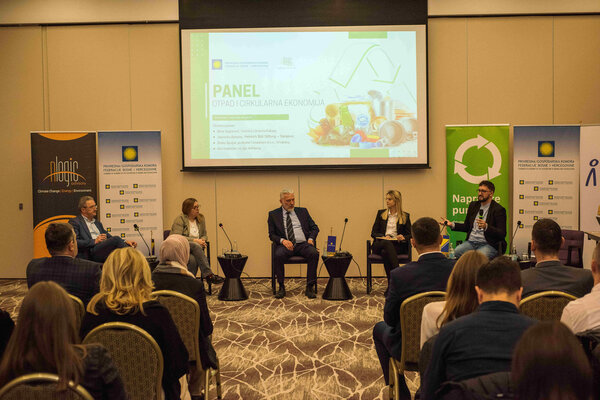
Organized by the Chamber of Economy of the Federation of BiH and the consulting company nLogic
Advisory, the two-day conference “WASTE-RESOURCE for the development of circular economy in BiH” was
held on 7 and 8 December 2023 at the Ibis Hotel in Sarajevo.
Panels, discussions and presentations accompanied the two-day event and resulted in the identification of key
guidelines for improving waste management and creating a sustainable future for Bosnia and Herzegovina.
By signing the Sofia Declaration, BiH committed to achieving climate neutrality by 2050 and accepted the
points of development and cooperation that include the circular economy as a way of integrating BiH into EU
industrial chains. Circular economy is a complete transformation of established linear business models and
requires changes throughout entire production, supply and consumption chains in order to be effectively
implemented. Although the circular transition is a complex process, it is worth implementing because of the
numerous benefits it brings in terms of economic and environmental sustainability of business, reduction of
waste and GHG emissions, health benefits, economic growth and the creation of new green jobs. The basic
prerequisite for the transition to a circular economy in BiH is the improvement of waste management, given
that currently valuable resources end up in landfills, and their valuation and utilization benefits municipal
companies, consumers and the economy.
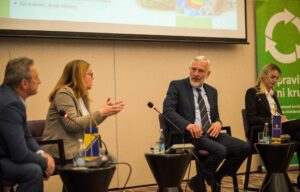
Panelists during the panel “Waste and Circular Economy” discussed financing possibilities, the current
situation and future activities in the implementation of circular business
models, optimizing resource use in manufacturing industries, extracting value from waste streams
and changing the behavior of producers and consumers toward circular practices. The panel participants
were: Almir Bajtarević, Heidelberg Materials in BiH; Jasminka Bjelavac, Heinrich Böll Stiftung
Sarajevo; Zlatko Šoljar, ConsultAre; and Ajla Imamović, nLogic Advisory. The moderator of this expert
panel was Hamdija Mujezin, CEO, Remote d.o.o/CSO, nLogic Advisory.
After an interesting discussion among all participants, the following conclusions were reached:
1. Follow good practices from the region in dealing with biowaste, and encourage composting
and biogas energy production;
2. Strengthen the role of the Information System for Waste Management in the Federation of BiH, and use the
available data as a basis for planning;
3. Increase the transparency and availability of data and strategic documents to the public, in order to
ensure citizen support and active involvement in further work;
4. Integrate circular economy concepts into companies’ business processes, and encourage
industrial symbiosis;
5. Establish a system of incentives and penalties for waste generation and management;
6. Mobilize additional support funds for the circular transition in municipal and private
companies, as well as
7. apply the triple helix approach in the development and implementation of strategic and action documents and
projects, thereby ensuring joint progress toward a circular future.

