
Taken from: PIT.BA
In a world where we face rapidly growing environmental challenges, the concept of waste is undergoing a transformation: traditionally perceived and treated as a burden, waste today, through the application of circular economy principles, can become a valuable resource.
How important this change is, and how necessary it is to adopt new perceptions and business models, is shown by the data: waste generation worldwide has increased significantly in recent decades and there is no indication that this trend will slow down. More than two billion metric tons of municipal solid waste (MSW) are generated annually globally, and this number is expected to increase by approximately 70 percent by 2050. Given the enormous quantities of waste, the need for adequate treatment and disposal services provided by the competent authorities is becoming increasingly important.
Waste is a resource
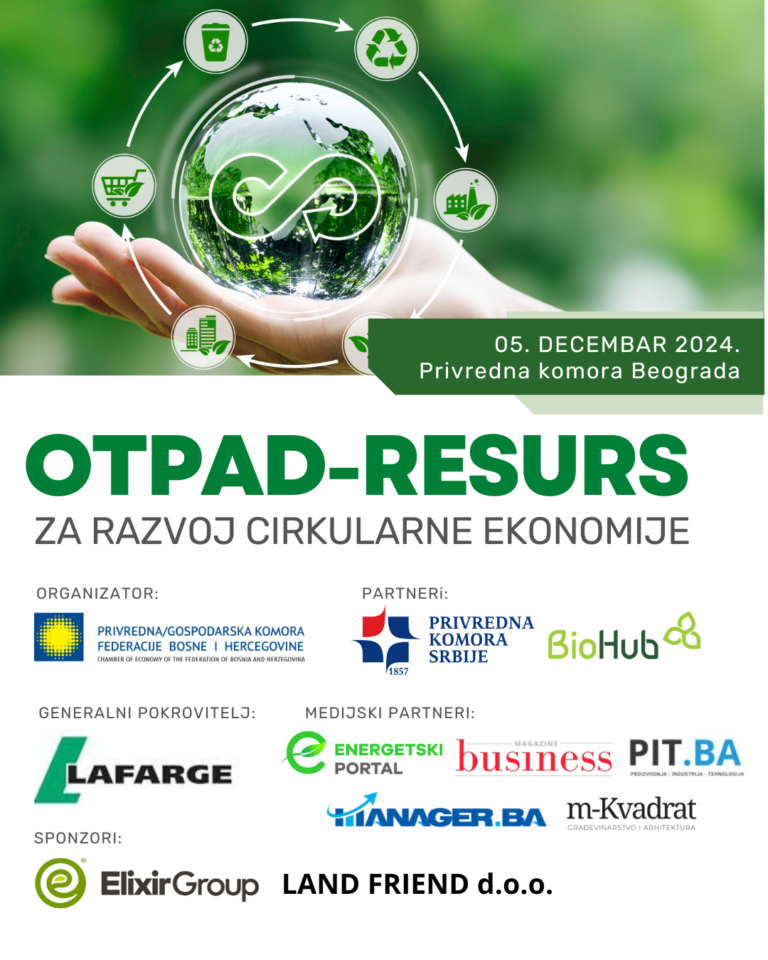
“WASTE – A RESOURCE for the development of the circular economy” is an international conference organized by the Chamber of Economy of the Federation of Bosnia and Herzegovina in partnership with the Chamber of Commerce of Serbia. It will be held on 5 December 2024 in Belgrade, and its aim is precisely to emphasize the need to change the current linear economic model. The countries of the Western Balkans are in the early stages of transition to a circular economy: legal frameworks for sustainable waste management are somewhat developed or are still being drafted, and operational capacities for applying circular practices are limited. The challenges are significant: “The key challenges of implementing the circular economy in our region include underdeveloped recycling infrastructure, outdated waste management systems, limited access to financing, low awareness, and an inadequate legal framework. Markets for secondary materials are limited, there is a pronounced need for modernization of facilities and digitalization of material flow management. Investing in education, awareness-raising, development of green skills and partnerships between sectors, along with technical and financial support for innovation, is key to achieving sustainable development goals and accelerating the circular transition”, Milena Rmuš, secretary of the Coordination Committee for Energy Efficiency and Environmental Protection at the Chamber of Commerce of Montenegro, tells the PIT.ba portal.
Good practices at Heidelberg Materials
The company Heidelberg Materials is an example of good practice, an industry working on the advancement and application of modern and sustainable solutions. At HM Cement BiH d.d. Kakanj, classical recycling is not carried out (as, for example, plastic or paper recycling is done). However, “in the production process we use waste streams (by-products) from other industries such as slag and ash from thermal power plants or slag from steelworks. These materials would otherwise be disposed of in the environment as waste, but we add these materials to clinker, a semi-finished product produced in a rotary kiln, and in this way the final product – cement – is obtained”, explains Almir Bajtarević, quality and environment manager at HM Cement BiH d.d. Kakanj.
“Depending on the type of cement, the content of additives ranges from 10 to 35%, but through the development of new technologies, we have managed to launch a new type of cement, CEM III (metallurgical cement), whose composition contains only 35% clinker and 65% slag,” he adds.
Bearing in mind the fact that clinker is the “carrier” of CO2 emissions, by adopting this product CO2 emissions have been reduced by 65% compared to the technical standard (CEM I), and this product has rightly been called “Ecocem”. “So, this is a classic application of the circular economy and we can say it is a 65% recycled product. In addition to by-products from other industries, cement plants around the world also use various types of waste as alternative fuel and thus directly contribute to reducing CO2 emissions. Thanks to the high combustion temperature in rotary kilns (1450 °C), various types of waste or waste-derived fuel (RDF / SRF) can be used completely harmlessly to the environment. This is of course done in a legally permitted and environmentally acceptable manner under controlled conditions with continuous monitoring of all air emissions, and strict controls of the physical characteristics and chemical composition of waste-derived fuel,” says Bajtarević.
Industrial symbiosis
Today, when cooperation and focus on common goals have no alternative, industrial symbiosis represents a key concept of the circular economy. “Industrial symbiosis is an important concept in the circular economy. It refers to mutual cooperation between companies where the waste or by-products of one enterprise are used as resources for another, thereby closing material loops. In practice, this means the possibility of exchanging or reselling by-products and waste materials, which reduces waste disposal costs and increases environmental efficiency. For example, waste from one production branch can be used as raw material in another, creating additional sources of income and contributing to the sustainability of the industry”, Rmuš points out. Bajtarević confirms this with concrete examples: “All over the world, substitute raw materials and additives (by-products from other industries) are used, and in this way millions of tons of waste (slag, clinker, ash,…) become an integral part of cement, i.e. concrete structures. In this way, recycling or energy recovery of various types of waste is carried out, reducing the use of non-renewable natural resources.” Along with industrial symbiosis, symbiosis of all actors in society is also needed. “In our country there is still not a single MBO plant (mechanical-biological waste treatment) that would turn waste into a product (RDF/SRF). Here, waste is still a problem. However, in ‘normal’ countries waste is not a problem, but a resource. Unfortunately, here this resource is still disposed of in the environment in various landfills (legal and illegal), and we can freely say that our society is still not aware of the opportunity offered by recycling and the circular economy”, Bajtarević makes clear.
Numerous participants in society, different sectors and initiatives can contribute significantly to solutions. Associations and chambers of commerce play a key role in the green transition. “Chambers of commerce provide guidance and support to the business community through education, organization of workshops and promotion of green business models. Through specialized hubs they enable companies to connect with experts and partners, while through cooperation with governments they propose legislative changes that facilitate the transition to a circular economy”, says Rmuš. The announced regional conference represents a significant contribution to updating the topic of waste as a resource, as well as to the exchange of good practices and initiatives for finding solutions. This event provides a platform for dialogue among key stakeholders, including industry, authorities and experts, thereby contributing to accelerating the process of transition to a circular economy in the region. The exchange of experiences and presentation of innovative solutions will enable further development of sustainable practices and encourage the implementation of more efficient waste management models, with the aim of reducing negative impacts on the environment and improving economic efficiency.


