
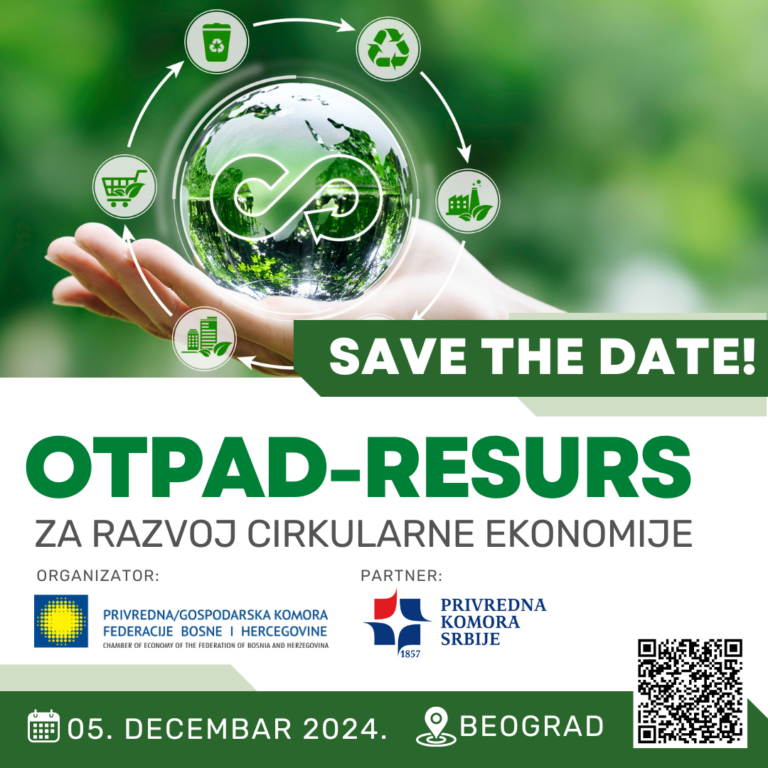
The Chamber of Economy/Commerce of the Federation of Bosnia and Herzegovina, in partnership with the Chamber of Commerce of Serbia, is organizing the international conference „WASTE-RESOURCE for the development of the circular economy“, on 05 December 2024 in Belgrade. The conference will bring together leaders in the green transition, decision-makers at all levels, institutes and experts, entrepreneurs, financiers, public utility companies, representatives of the non-governmental sector and the media. The conference will present best practices in the low-carbon economy and access to green financing.
CIRCULAR ECONOMY THE PATH TO SUSTAINABLE USE OF RESOURCES
In order to stimulate economic growth and social progress, while preserving a healthy and clean environment, the European Union introduced significant changes to the legal framework at the end of 2015 and allocated huge funds to modernize the economy, strengthen its stability and competitiveness, and create new jobs. The current linear model of the economy implies uncontrolled exploitation of natural resources and the flow of materials from the factory through the user to the landfill. The circular economy influences the change of business models, habits and ways of thinking of both producers and consumers, because the new eco-design of products extends their lifespan.
By 2019, the 54 goals contained in that Action Plan had been fulfilled, although the implementation of some activities is still ongoing. In March 2020, the European Commission adopted a new Circular Economy Action Plan (CEAP), with the following goals:
• make sustainable products the norm in the EU;
• focus on sectors that use most resources with high potential for circularity, such as: electronics and ICT, batteries and vehicles, packaging, plastics, textiles, construction and buildings, food, water and nutrients;
• ensure less waste: reduce total waste generation and halve the amount of residual (non-recycled) municipal waste by 2030;
• empower consumers and public procurement buyers;
• make circularity work for people, regions and cities; and
• lead global efforts in the field of circular economy.
The EU is developing a comprehensive framework to support the transition to a circular economy. This framework includes various types of initiatives, including:
• Regulatory initiatives: These are legislative measures that go through the EU policy-making process, usually in the form of regulations or directives.
• Strategic/comprehensive initiatives: These initiatives outline the future direction of policy for specific areas or topics, providing guidance for future policy development.
• Voluntary initiatives: These are non-binding initiatives that encourage voluntary actions and commitments without legal obligations.
Do not miss the opportunity to be part of this event, share good knowledge and practices.

