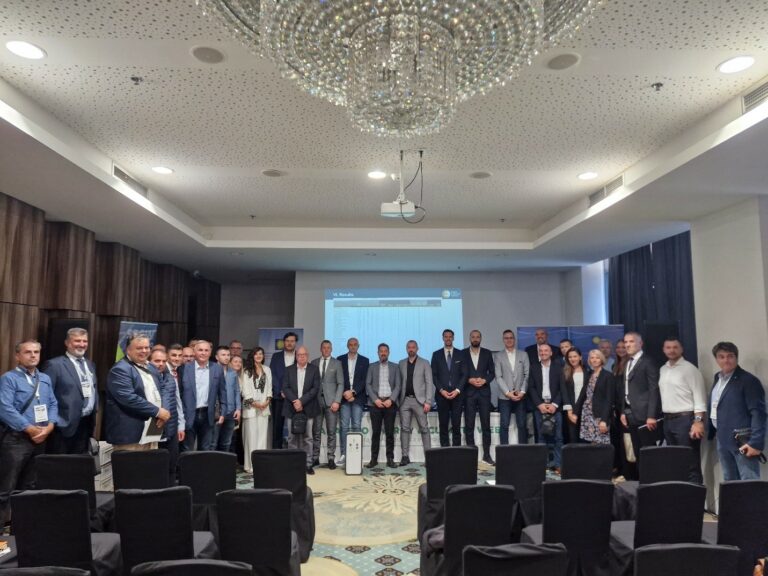
Within the Sarajevo Energy and Climate Week, held from 23–27.09.2024, a joint meeting was held of the Association for Electromobility and the Association of Authorized Dealers and Car Traders operating within the Chamber of Economy of the Federation of Bosnia and Herzegovina.
The meeting was attended by a large number of members representing companies from the automotive industry, power engineering, electrical industry, transport, environmental protection, oil and petroleum products distribution, as well as entities from other sectors. The aim of the meeting was to summarize past activities, present the current situation with an overview of challenges and their potential solutions, and outline the plan for upcoming activities.
In the introductory address, Anela Karahasan, secretary of the mentioned associations, reviewed the past activities of the Association for Electromobility, where the innovation of the company Core d.o.o., Sarajevo, was especially welcomed through the presentation of the first Bosnian-Herzegovinian electric scooter. Progress in Tuzla Canton was also welcomed, which issued a public call for the construction of charging stations funded from Eco Tax fees.
At the same time, it was emphasized that one of the key barriers to the development of electromobility in Bosnia and Herzegovina remains insufficiently developed infrastructure, where slow chargers dominate and there is only one fast charger along the entire Corridor. An additional pressing issue, apart from obtaining a building permit, is the price of charging services, where charging-station owners at hospitality facilities, shopping centers, hotels, etc., charge between 5 and 50 KM for use of a slow AC charger, which is significantly higher than the actual electricity consumption.
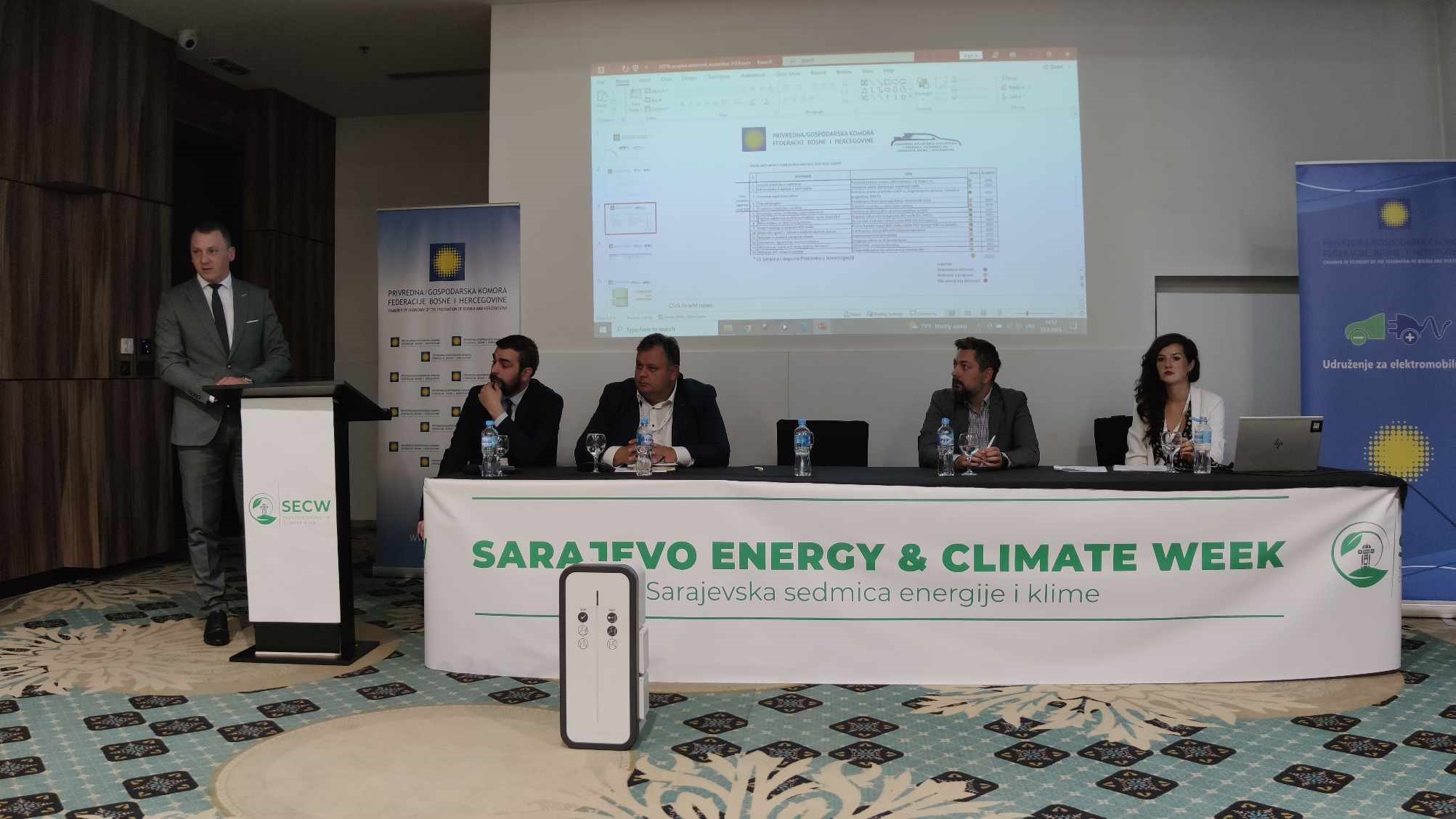
Miro Sesar, president of the Association of Authorized Dealers and Car Traders, presented the market situation, with special reference to the number of newly registered electric and hybrid vehicles before and after the adoption of the Council of Ministers of Bosnia and Herzegovina Decision on suspending customs duties on the import of electric vehicles and reducing them to 5% on the import of hybrid vehicles.
In the market analysis, the importance of the subsidy under the Government of the Federation of Bosnia and Herzegovina Decision for the purchase of new electric vehicles was also highlighted, but for better results these two measures must be synchronized in time. In this regard, the total car market for the first 7 months of 2024 recorded 7,427 vehicles, while in 2023 it recorded 6,941 vehicles for the same period. The total market for electric and hybrid vehicles for the first 7 months of this year recorded a total of 422 vehicles, while in 2023 it recorded 336 vehicles for the same period. Accordingly, the Association will this year again submit an initiative to the Ministry of Foreign Trade and Economic Relations of Bosnia and Herzegovina to extend the Decision on the suspension of customs duties for 2025 as well.
Members of the Association were also presented with other activities, with special reference to the Rulebook on Registration, the Rulebook on Homologation, and the issue of the Regulation on Other Categories of Waste. As one of the upcoming activities, members highlighted the need to initiate the suspension of customs duties on the import of N1 category vehicles, taking into account the economic and environmental effects that would be achieved.
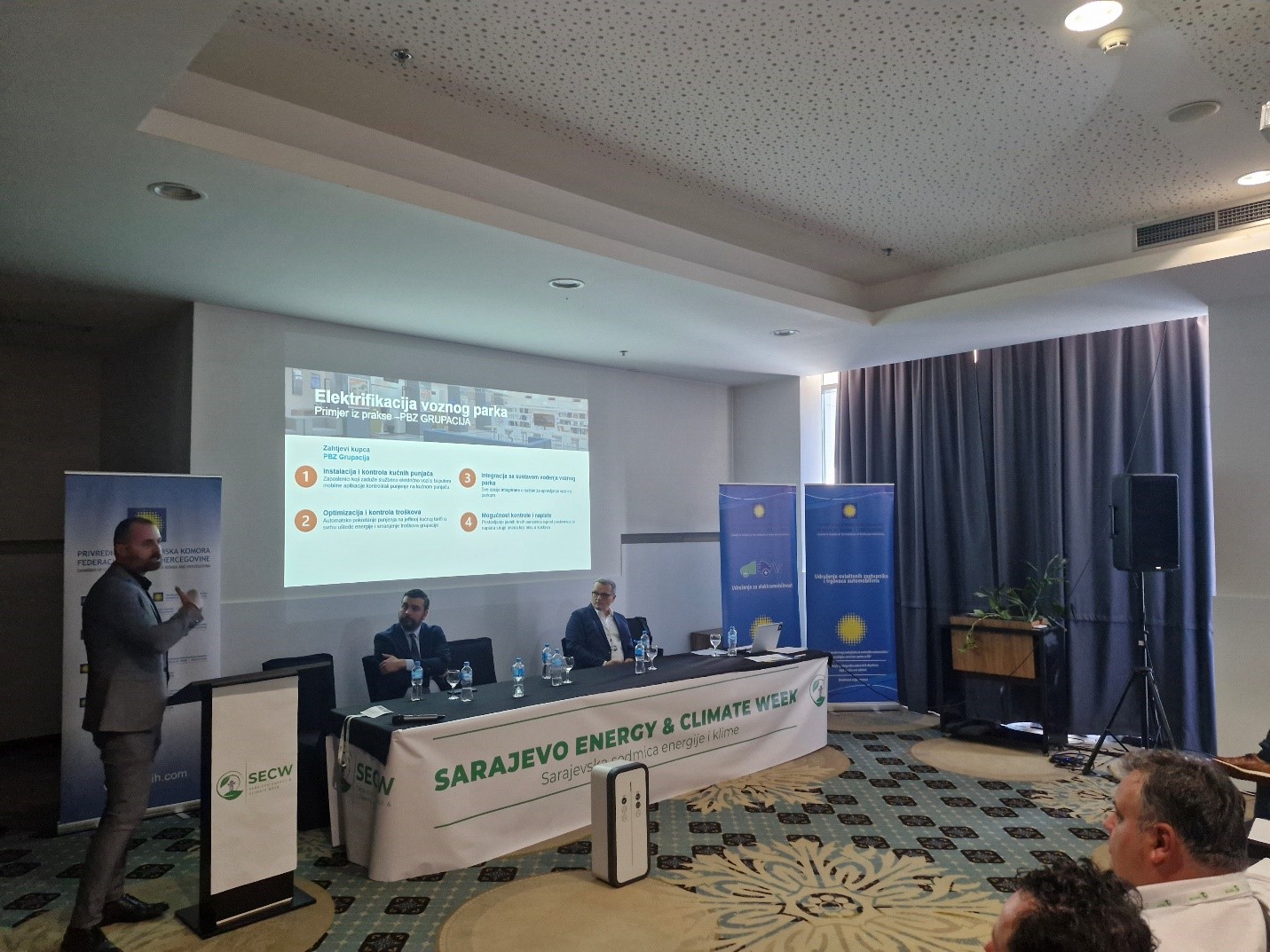
In the second part of the meeting, a workshop was held on the topic: “The state, challenges, and practical experience of charging infrastructure in Bosnia and Herzegovina,” presented by Dejan Šćepanović (Hager d.o.o.) and Josip Šarić (Unistelekomunikacije dd), as well as “Evaluation of public charging stations in Slovenia,” presented by Ignac Završnik, president of the Slovenian Society for E-Mobility. The aim of the workshop was to point out the situation in Bosnia and Herzegovina and how to apply examples of good practice from the region.
In his presentation, Ignac Završnik particularly emphasized that electromobility is primarily an economic model, and then an environmental one, which can thrive through joint cooperation of the public and private sectors, as long as the price of electricity remains more favorable than the price of fuel for internal combustion vehicles. Through constructive discussion and their large attendance, the members once again confirmed their commitment to electromobility as a new business opportunity in Bosnia and Herzegovina from economic, environmental, tourism, and innovation perspectives, but with the necessary systemic support, primarily related to customs duty suspension, subsidies, and the construction of charging infrastructure.
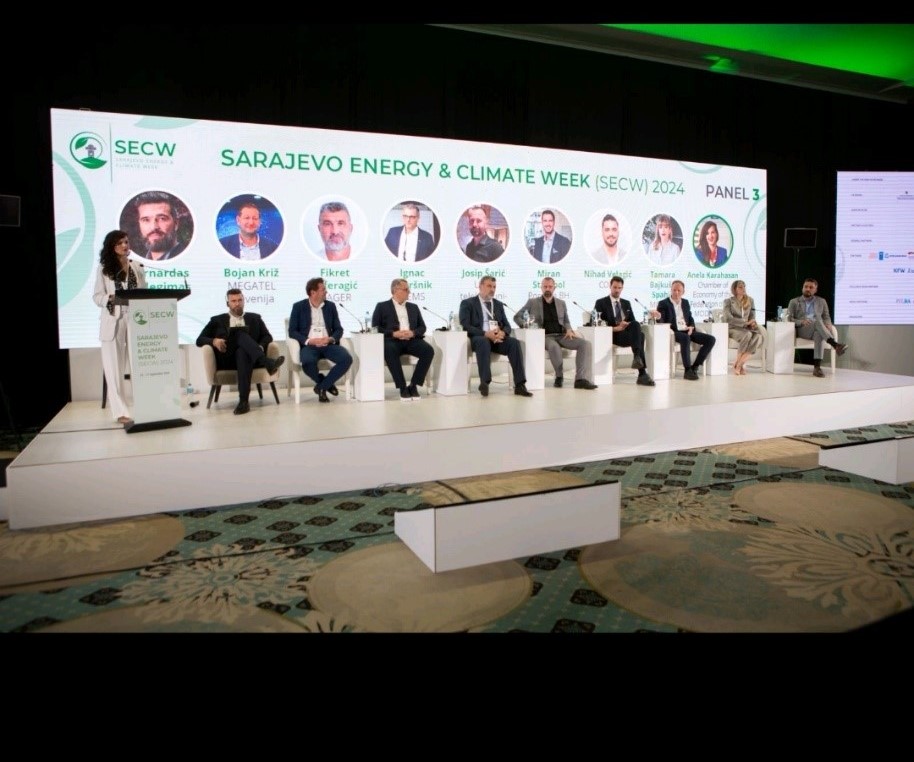
After the meeting, a panel discussion was also held on the topic: “A strategic approach to the development of electromobility in the private and public sectors with a focus on transport decarbonization,” within the SECW conference. Panel participants were representatives of the public and private sectors: Tamara Bajkuša-Spahić – MVTEO BiH, Bojan Bošnjak – Minister of Communal Economy, Infrastructure, Spatial Planning, Construction and Environmental Protection in the Government of Sarajevo Canton, Ignac Završnik – DEMS – Society for E-Mobility Slovenia, Bernardas Padegimas – Stockholm Environment Institute SEI, Miran Stambol – Porsche Sarajevo, Fikret Seferagić – HAGER Sarajevo, Nihad Velagić – CORE d.o.o., Bojan Križ – MegaTel Slovenia, Josip Šarić – Unis telekomunikacije d.d. Mostar, while the panel was moderated by Anela Karahasan, secretary of the Association for Electromobility.
During the discussion, it was emphasized that although there are small advances in the development of electromobility in Bosnia and Herzegovina, they are still not sufficient. In the conclusion of the panel, the panelists confirmed that for more significant development of electromobility in Bosnia and Herzegovina, as a new business model, a joint strategic approach of the public and private sectors is necessary, precisely under the auspices of the first day of the SECW conference: “Together towards carbon neutrality.”