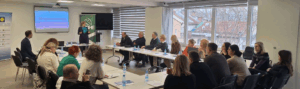
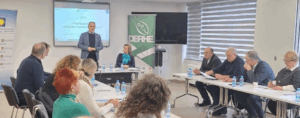
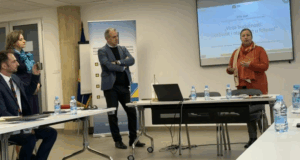
After the welcome remarks by the President of the Chamber of Economy of the Federation of Bosnia and Herzegovina, Mirsad Jašarspahić, Minister Prof. Dr. Dušanka Bošković (Ministry of Science, Higher Education and Youth, Sarajevo Canton) addressed those present and opened the info day #DERHE titled “Vision of the Future: Sustainability and Resilience in Focus,” held on 2 February 2026, organized by the Chamber of Economy of the Federation of Bosnia and Herzegovina and the Faculty of Agriculture and Food Sciences of the University of Sarajevo in Sarajevo, partners on the Project. Minister Bošković emphasized that modern technology enables us to face individual challenges and create tailored solutions, improving system agility and involving all participants. She stressed the need to strengthen digital and green capabilities/skills in ways that change our thinking, change the way we think about development, and benefit society as a whole. This was the central theme of the info day and the #DERHE project – Digital Education Readiness in Higher Education, No. 101128628; ERASMUS-EDU-2023-CBHE.
During the info day, discussion focused on the negative impact of the current approach to business and the use of modern technologies, as well as the negative impact of the way we live, eat, and especially how we choose, use, and waste food. According to UNDP, 15.4% of human development in Bosnia and Herzegovina (BiH) – a measure of quality of life encompassing health and individual well-being – is lost due to excessive CO2 emissions and unsustainable resource consumption (UNDP, 2025). The modern concept of quality, which increases value for all stakeholders by promoting monitoring, self-assessment, and continuous improvement in all aspects of business, represents the “hidden gem” of the necessary transformation. This framework has been partially or fully implemented across the food system, indicating that the transformation has begun but has not yet been fully recognized. This framework should be used to create a platform for innovative solutions and incentives that reduce environmental pressure and improve quality of life. To drive these changes, it is crucial to strengthen the green and digital skills of students and future decision-makers. This initiative is the focus of the complementary EMPHASIS project (Empowering Higher Education through a Collaborative Approach for Sustainable Practices and Energy Efficiency; ERASMUS+), which was discussed during our meeting.
Several barriers hinder the implementation of business models aimed at reducing negative pressure on the planet. One important barrier is the lack of reliable methods for monitoring/recording and verifying the actual reduction in pressure achieved through specific production models (e.g., carbon-based agriculture). The solution is offered by a highly sophisticated and comprehensive platform developed within the NGO CENER 21 project – Accelerating the development of the carbon market for climate change mitigation and adaptation in Mediterranean agriculture. This platform will enable farmers from Bosnia and Herzegovina to participate in the carbon credit market and secure additional investments, improving lives in rural areas and across Bosnia and Herzegovina.