
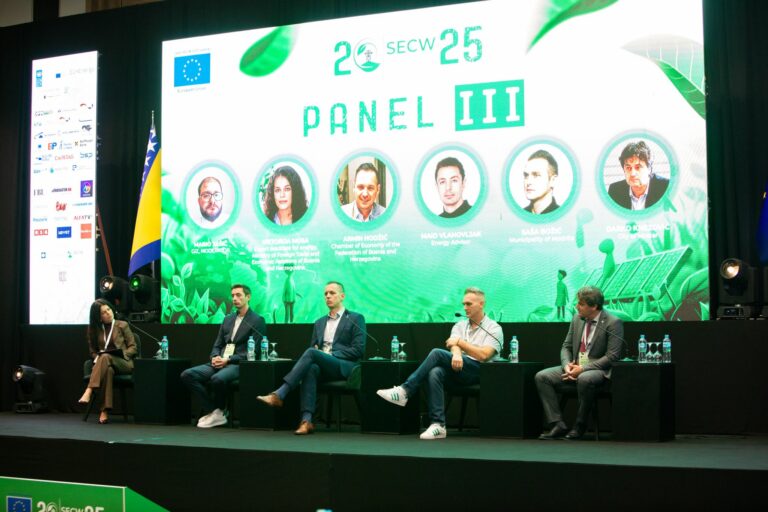
The second day of the Sarajevo Energy and Climate Week (SECW) was marked by panels that opened new questions and offered innovative answers to the challenges of decarbonization. Through dynamic discussions, participants emphasized that innovative pathways are key to accelerating the green transition and creating a sustainable future.
The program of the second day of the conference consisted of 6 panel discussions and 7 side events.
The first panel discussion of the second day of the conference was titled: “Regional climate partnership between Germany and the Western Balkans: Synergy of renewable energy technologies, storage and grid infrastructure”. The panel brought together experts from the region with experience in renewable energy, storage, transmission infrastructure and financial mechanisms projects and was organized by the German development bank, KfW.
During the panel, energy transitions were discussed, which in themselves represent more than a replacement of fossil fuels with renewable sources because they represent a systemic transformation that includes the strategic integration of different technologies, from hydropower plants, wind farms, photovoltaic plants, battery storage, to green hydrogen and adequate grid solutions. The aim of this panel discussion was to provide a platform for expert exchange of knowledge and experience regarding the systemic integration of renewable energy technologies, taking into account technical, regulatory and investment aspects. The discussion enabled a deeper understanding of the synergistic links between different components of the power system, and the identification of concrete steps and recommendations for accelerating the transition in the countries of the region.
The second panel discussion was titled “Empowering people: Innovative changes in communities” and was organized under the auspices of the “EU4CAET” Project funded by the EU, co-financed by the German Federal Ministry for Economic Cooperation and Development (BMZ) and implemented by GIZ, in cooperation with the project “Community Action for Energy Transition (CAET) in BiH”, funded by the German Federal Ministry for Economic Cooperation and Development (BMZ) and implemented by GIZ.
The panel aimed to present opportunities for designing innovative energy projects in Bosnia and Herzegovina, with a special focus on the current legal framework needed to obtain the status of a renewable energy community. The basic legal framework for renewable energy communities has already been adopted, while by-laws have been adopted in the Republika Srpska, and are in the process of adoption in the Federation of Bosnia and Herzegovina and the Brčko District of BiH. Local governments were also discussed, which have a key role as drivers and holders of renewable energy community projects, because they best understand the needs of citizens and local businesses, and can effectively connect energy changes with everyday life and the needs of the community. The panel also presented the work of the CAET and EU4CAET projects, which provide technical assistance to local government units in BiH in the process of establishing renewable energy community projects. The closing remarks of the panel were given by moderator Mario Jašić, GIZ, who emphasized the importance of legal frameworks within which energy communities are implemented, and encouraged local governments to, within their competencies, locally facilitate the green transition aimed at enabling a greater number of energy projects for legal entities and individuals.
Part of the program of the second day of the conference was also a panel discussion entitled: “Dynamics of the development of the electricity market in the region”, organized by the “EU4Energy” Project funded by the EU. The panel focused on key aspects of adapting to EU regulations and trends in the electricity market. The discussion also covered the importance of adopting the Law on the Regulator, Transmission and Electricity Market of Bosnia and Herzegovina, its implementation, and the process of establishing an electricity exchange, as well as the formation of an organized electricity market for day-ahead and intraday trading. Special attention was paid to the nomination of the Nominated Electricity Market Operator (NEMO), interconnection with neighboring electricity markets, which will enable easier integration and reduction of potential costs, including avoiding CBAM taxes on electricity.
The panel communicated recommendations on establishing an electricity exchange in BiH from a study prepared by the EU-funded project “EU4Energy” in cooperation with NORD POOL, and provided guidelines for creating an efficient and sustainable electricity market that has the potential to improve the energy security and competitiveness of Bosnia and Herzegovina, as well as the countries of the region within the European regional market.
An opening statement was also given by Almir Imamović, who emphasized the importance of international support in resolving key issues, and bringing state institutions closer to existing exchanges, power utilities and other electricity market participants.
UNDP was the organizer of the panel discussion titled: “Energy transition and new models of the energy market”. The panel dealt with the transition to sustainable energy systems in Bosnia and Herzegovina (BiH) and the region, with a focus on innovative approaches such as the ESCO (Energy Service Company) model and other similar solutions. In addition to the ESCO model, the panel also considered other approaches, such as public-private partnerships (PPP), which enable cooperation between the public sector and private companies in order to improve energy infrastructure and services. In the regional context, BiH and neighboring countries are part of the Energy Community, which seeks alignment with EU energy standards, opening up opportunities for the application of such models. The panel further focused on exploring the advantages of these models, the challenges in their application in BiH and the region, and potential solutions for creating a more sustainable and efficient energy market.
The EU-funded project “EU4Energy” organized a discussion on barriers and incentives for the development of electromobility. The panel discussion focused mainly on the key challenges that Bosnia and Herzegovina and the region face in the process of implementing electromobility. The discussion covered issues related to the construction of infrastructure for charging electric cars, including an insufficient network of charging stations, as well as problems related to the lack of an adequate regulatory framework, in light of a recent analysis conducted through the EU4Energy project funded by the European Union. Within the panel, special attention was paid to the need to harmonize laws at different levels of government in order to facilitate the transition to sustainable transport. Participants discussed the importance of subsidies as a tool to encourage the use of electric cars and reduce CO2 emissions in the transport sector. Through constructive discussion, the panel aimed to contribute to the decarbonization of the transport sector and the realization of sustainable energy solutions that will meet the needs of society and protect the environment.
The last panel discussion was on hydrogen, decarbonization of industry, organized by the EU-funded project “EU4Energy”. The panel brought together the academic community, experts in the fields of energy, industry, climate and ecology, who shared their experiences and best practices. The aim of this panel was to emphasize the importance of green hydrogen as a key element of the Decarbonization Package. The discussion will focus on the potential that Bosnia and Herzegovina and the countries of the region have in this area, as well as on the role of green hydrogen in meeting the European Union’s goals related to reducing emissions and achieving sustainable energy solutions. The panel presented the Hydrogen Roadmap for Bosnia and Herzegovina, prepared with the support of the EU4Energy project funded by the European Union, which includes key steps toward implementing the infrastructure and technologies needed for the production and use of green hydrogen in BiH. Participants considered guidelines for the further development and use of hydrogen, with special emphasis on the decarbonization of industry and transport. Concrete recommendations were developed to help integrate green hydrogen as a vital part of the energy transition, empowering Bosnia and Herzegovina and the region in line with global climate goals and sustainable development.
The second day of the conference was also marked by side events organized by SEI, IREI, GIZ, People in Need, EU4Energy funded by the EU and the Chamber of Economy of the Federation of BiH.
One of the partner countries of this year’s SECW is the United Kingdom. Courtesy of His Excellency, Julian Reilly, Ambassador of the United Kingdom, and with the wholehearted support of the UK embassy team in Bosnia and Herzegovina, the second day of SECW concluded in an excellent atmosphere at a VIP reception at the embassy. This was another opportunity for the exchange of opinions and experiences, as well as for creating new connections and developing project ideas.

