
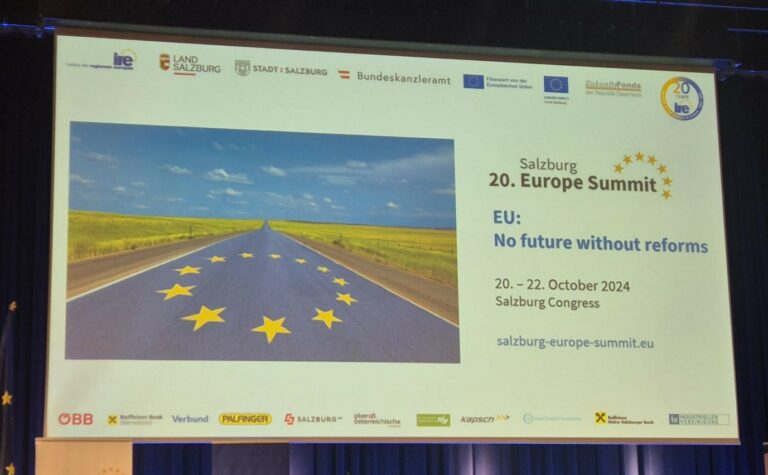
At the invitation of one of the organizers of the 20th EUROPA SUMMIT held in Salzburg, Republic of Austria, representatives of the Chamber of Economy of the Federation of BiH participated in the international conference held this year under the patronage of the Federal Chancellor of the Republic of Austria, Mr. Karl Nehammer.
This year’s summit theme, “EU: No Future Without Reforms”, reflects the urgent need to rethink European political, economic and security strategies, especially in light of current global challenges. The accession process of the six Western Balkan countries, long delayed, has now been joined by three candidates: Ukraine, Moldova and Georgia. However, not only are the candidate countries still far from accession, but the EU itself is by no means ready for new members. The European Union describes enlargement as a “geopolitical investment”; for peace, prosperity and security in Europe.
The two-day program consisted of several very important and current panel discussions. The panel topics, or reflections on the stated themes, are significant not only for EU member states, but also for countries that plan to become members.
The first panel discussion on the topic that is also the title of the entire event highlighted the necessity of EU enlargement, better coordination among its current members, as well as constructive cooperation with Turkey without its full membership, a possible change in the role of the US toward Europe in the future, and a change in relations between the EU and Great Britain. The topic of the second panel discussion was “EU enlargement – a geopolitical necessity,” described as an investment for peace, prosperity and security in Europe. Twenty years ago, the EU grew by 10 new members, in 2007 two more countries joined, namely Bulgaria and Romania, and the last EU enlargement took place in 2013 when the Republic of Croatia became a full member of the EU family. For the past approximately 20 years, the 6 Western Balkan countries (WB6) have been waiting for their chance, which they have still not received, ultimately resulting in a loss of credibility of the EU member states and their principles. Participants in this panel also included the High Representative in BiH Christian Schmidt and the Deputy Minister of Foreign Affairs of BiH Josip Brkić.
The third panel was particularly interesting given the increasingly frequent discussion these days, namely “How can the EU remain competitive?” Competitiveness, in the long term, the potential for sustainable growth as well as the broader European internal market are the backbone of prosperity in Europe. If the EU economy wants to remain strong or among the strongest, then it means it must do everything it can to be at the forefront of innovation worldwide. Here, the fact was particularly emphasized that the EU is making slower progress when it comes to future technologies such as artificial intelligence and digitalization. The main stumbling blocks are administrative burdens and overly extensive bureaucratic processes.
The fourth and perhaps most interesting panel was titled “The EU on the path to an energy union,” which considered the EU as a common electricity and gas market, from Portugal to Finland and all other EU countries that would be supplied with affordable and clean energy. Energy and gas should be exchanged through appropriate infrastructure without any regulatory barriers. This is especially important from the aspect of EU energy supply, because the EU imports one fifth of all energy produced in the world annually, while 53% of total energy needs are covered by imports amounting to approximately 400 billion euros.
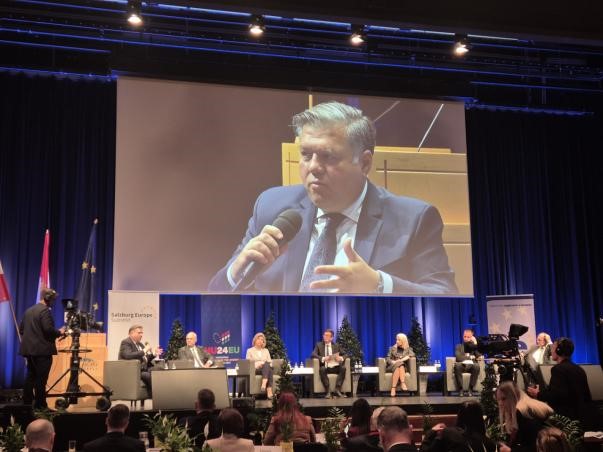
After two days of intensive talks, discussions, exchange of opinions and experiences, and plans for the future, the 20th European Summit in Salzburg concluded more than successfully.

