
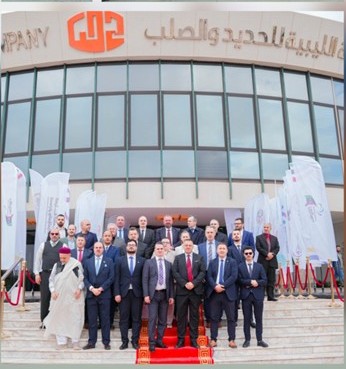
The first Libyan-Bosnian business forum was held on March 29 and 30 in Misrata, Libya’s industrial and logistics center, more precisely at the Libyan Iron and Steel Company, and was described as a potential turning point in economic relations between Libya and Bosnia and Herzegovina, reflecting the level of participation and strategic ambitions behind this initiative.
At the same time, it is also an invitation to companies from Bosnia and Herzegovina, whose focus is engineering, to engage more freely in the region of Libya and North Africa, following the experience of firms already present, such as Energoinvest, Bosna Petroleum Company and Bosna S.
The forum was organized by SANA Business Consulting & Exhibitions, led by Salem Zeidan, under the patronage of the Libyan Iron and Steel Company, headed by Dr. Mohamed Abdelmalik Al-Faqih, who last year led a delegation of Libyan companies to the ZEPS fair.
Bosnia and Herzegovina was represented by a delegation of 15 members from the public and private sectors: Samir Šibonjić, Minister of Economy of Zenica-Doboj Canton; Mirsad Jašarspahić, President of the Chamber of Economy of the Federation of BiH; Mirsad Heleg, advisor to the Mayor of the City of Zenica; Selver Keleštura, Secretary of the City of Zenica; Snježana Vrhovac, Chairwoman of the Zenica City Council; Sumeja Mujkanović, Assistant Mayor; Prof. Dr. Bahrija Umihanić, full professor; Jasmin Šarić, Director of JKP “Radnik” Zavidovići; Fahrudin Šahmanija, owner of FE-Metal Zenica; Senaid Husić, owner of Bontex Maglaj; Kenan Agić, owner of Metalon Visoko; Elvir Ajanović, General Director of the ZEPS fair; Jasmin Baručija, owner of Glovis d.o.o. Zenica; Sanel Ibrić, Executive Director of the ZEPS fair; and Ibrahim Salihović, translator.
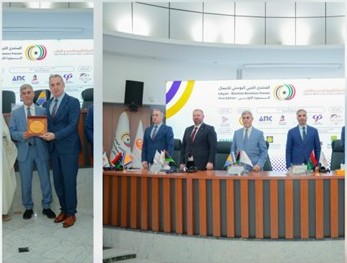
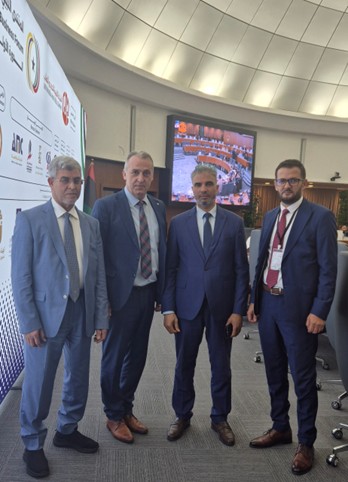 In the atmosphere of the recently signed strategic partnership agreement, worth 3 billion dollars, with the Qatari fund and the Swiss-Italian shipping and logistics giant MSC, for the expansion and development of the port of Misrata, which together with the Misrata Free Zone (MFZ) forms one whole, they proudly emphasized that they will increase the port’s capacity to four million containers per year and expand the free industrial zone alongside the port, with the possibility of expansion to 20,000 hectares.
This speaks of the strong reindustrialization of the country, returning it to the map of attractive locations for investors and engineering companies in the energy and industrial sectors.
In addition to Libyan companies, representatives of Bosnian-Herzegovinian companies present on that market, such as Energoinvest and Bosna Petroleum Company, also actively participated in the forum.
The President of the Chamber of Economy of the FBiH, Mirsad Jašarspahić, paid special attention to the potential of the Bosnian-Herzegovinian engineering sector, which has always been the backbone of economic cooperation with this part of the world.
The hosts from Libya emphasized that the interest of this country in economic cooperation with Bosnia and Herzegovina has never ceased and that in this sense they have been trying to find serious partners over the past ten years. During the stay in Libya, the Bosnian-Herzegovinian delegation additionally visited metal industry companies in the industrial zone integrated around the Libyan Iron and Steel Company. B2B meetings were organized between companies from BiH and Libya, as well as bilateral meetings between the competent ministries and institutions.
During the stay in Libya, the Bosnian-Herzegovinian delegation additionally visited metal industry companies in the industrial zone integrated around the Libyan Iron and Steel Company. B2B meetings were organized between companies from BiH and Libya, as well as bilateral meetings between the competent ministries and institutions.
Significant participation of companies from Libya at the ZEPS 2026 fair was also announced, as well as the organization of the next business forum in Zenica, further strengthening the international character of this event.
The visit to Libya marks the beginning of real economic engagement between the two countries, focused on direct partnerships, new investment channels and connecting Libyan and European markets, using the potential and logistics of the “Union for the Mediterranean (UfM)”.

