
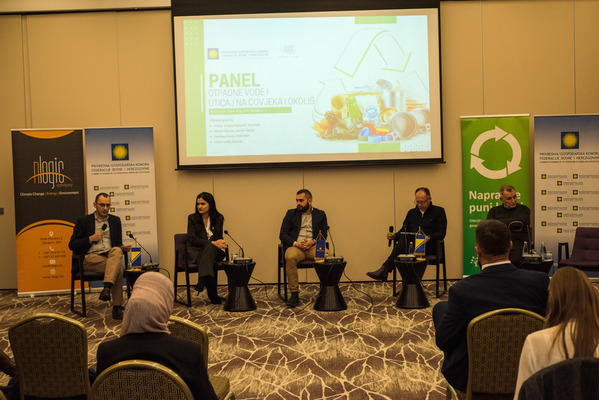
The aim of the recently held conference “WASTE-RESOURCE for the development of the circular economy in BiH”, organized by the Federation of BiH Chamber of Economy and the consulting company nLogic Advisory, was to create conclusions that will serve as the basis for future action in addressing the mentioned issue.
As part of the conference, a panel titled “Wastewater and its impact on humans and the environment” was held, with participants: Atif Hodžić, AD HARBI d.o.o.; Nermin Taletović, Adriatic Metals; Adnan Hodžić, Remote d.o.o.; and Sendžana Muslić, P/G K FBiH. The moderator of this expert panel was Prof. Dr. Samir Đug, Faculty of Science, University of Sarajevo.
During the panel, a broad range of human activities and their impact on the environment was discussed. These impacts are extensive and diverse and often include very negative pressures on ecosystems, biodiversity, climate, and air and water quality. These effects arise from activities related to population growth, industrialization, agriculture, urbanization and resource exploitation. Wastewater, which includes municipal sewage, industrial wastewater and agricultural wastewater, can have a significant negative impact on the environment if not managed properly.
The mining industry can have a significant and diverse impact on the environment, especially on water resources, both surface waters (rivers, lakes and streams) and groundwater. These impacts arise from mineral extraction, ore processing and the disposal of waste materials. The severity of these impacts depends on numerous factors such as the type of mining, the minerals extracted and the efficiency of environmental management practices. Responsible mining practices, proper waste management and the application of environmental regulations are key to mitigating these impacts. Sustainable approaches to mining that prioritize water conservation, pollution prevention and community engagement can help reduce the negative effects of mining on water resources. In addition, continuous monitoring and adaptive management strategies are key to addressing and mitigating environmental impacts throughout the life cycle of mining operations. A good example of integrating environmentally and socially responsible practices into business strategy is the operations of Adriatic Metals in Bosnia and Herzegovina. This approach, often referred to as corporate social responsibility (CSR) or sustainable business practice, goes beyond mere compliance with regulations and reflects a commitment to ethical, social and environmental issues to which this company is dedicated. Consumers increasingly prefer companies that demonstrate commitment to sustainability and social responsibility. Adopting environmentally and socially responsible practices can improve a company’s reputation, build trust and create a positive image. Integrating responsible practices helps mitigate various risks, including risks related to resource scarcity or environmental impact. Certainly, in the decision-making process and development strategies, quality and scientifically based data are of key importance. Young ecologists and scientists can play a significant role here, bringing new perspectives in modern society and making valuable contributions to this field. Their views are shaped by a combination of formal education, research experience, technological progress and increased awareness of global challenges. Ecologists recognize the interconnection of ecosystems with social, economic and political factors. By adopting an interdisciplinary approach to solving environmental problems, they cooperate with experts from various fields to address complex environmental issues. Growing up in the digital age, young scientists use modern technologies for data collection, analysis and communication, such as remote sensing, GIS (Geographic Information System) and data modeling to improve their environmental research.
Only in this way is it possible to achieve and realize the principles of balanced development to which Bosnia and Herzegovina aspires. Preserving a quality environment should enable the further economic development of our country while ensuring quality resources and environment for future generations as well.

